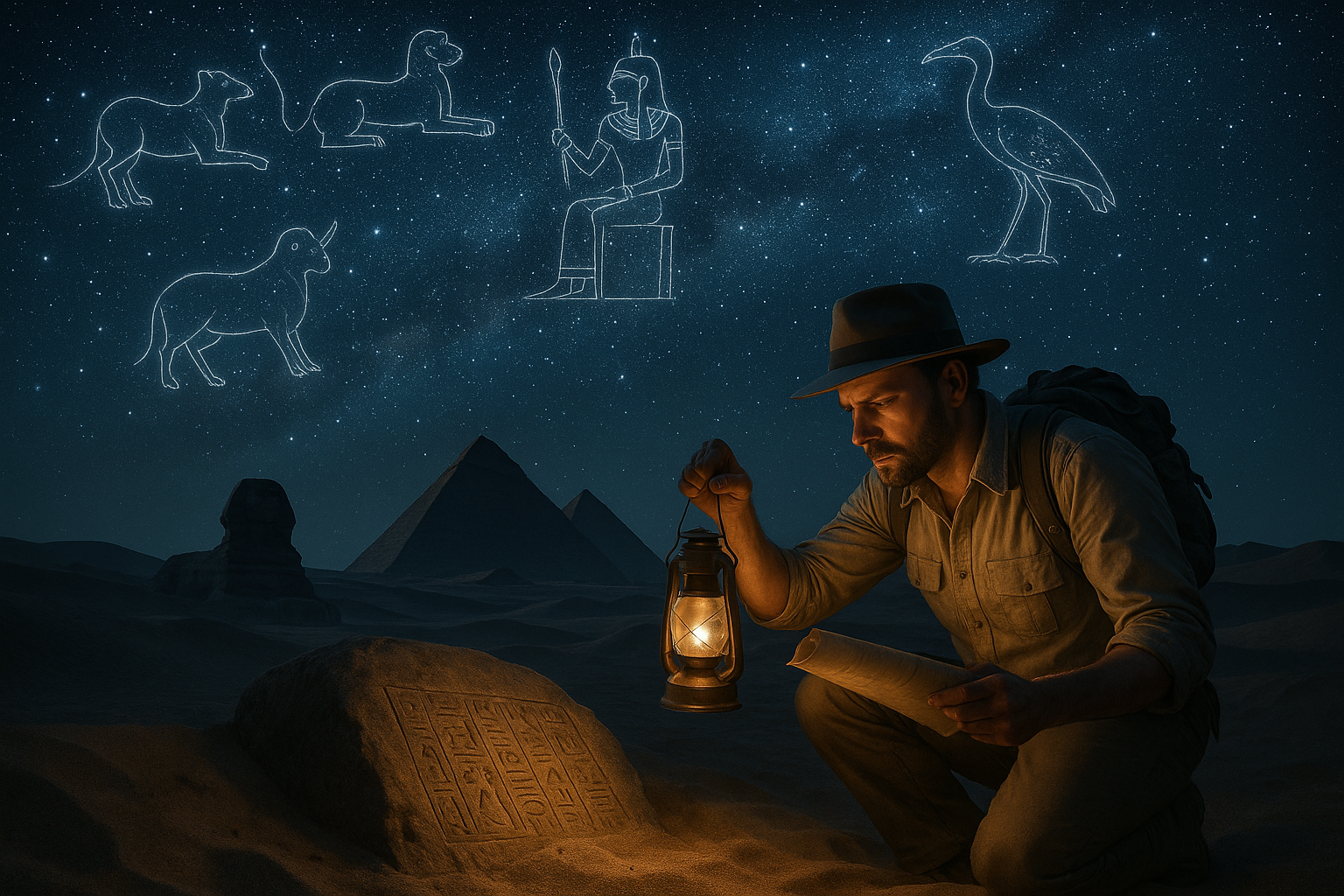
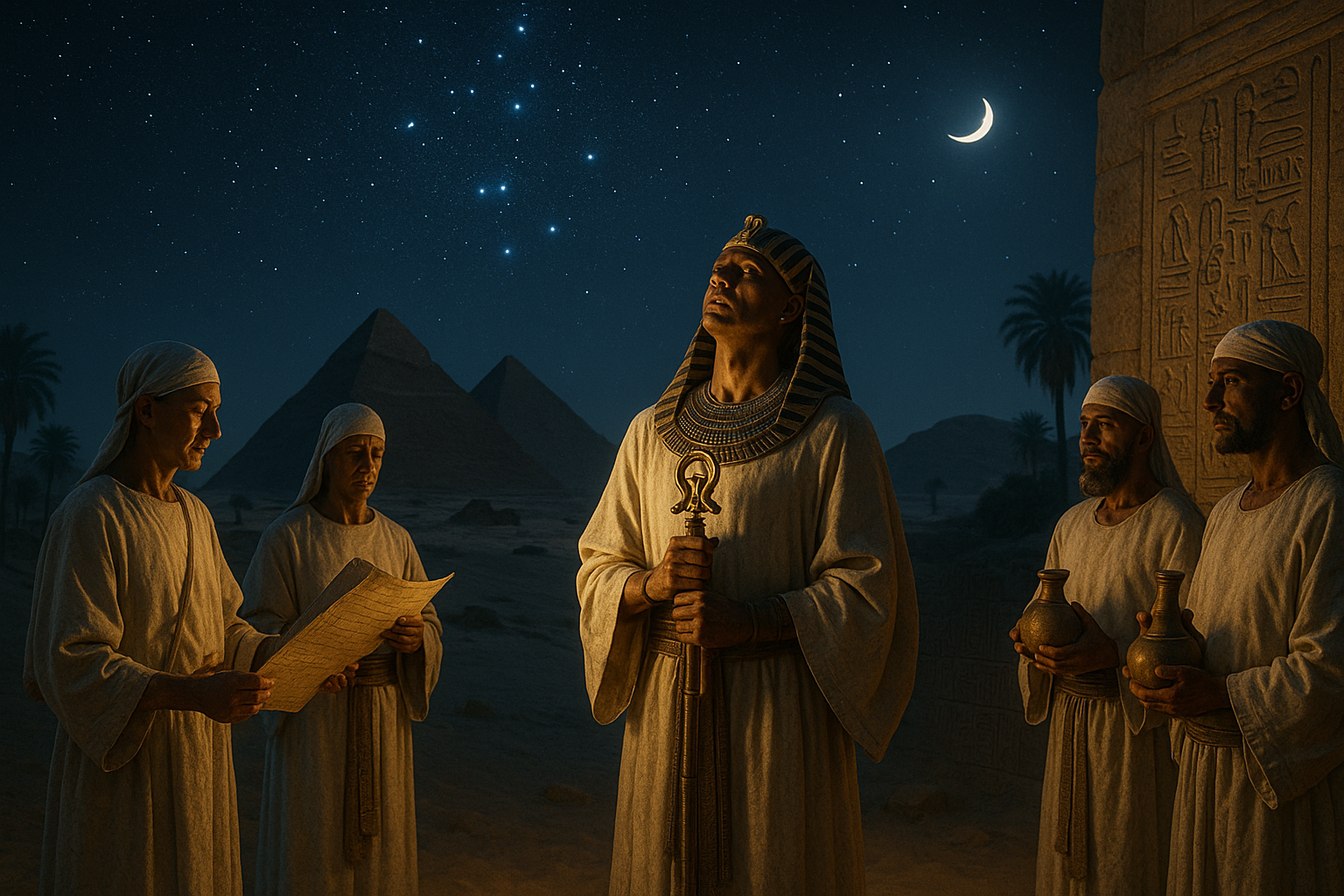
The enigmatic allure of the cosmos has always fascinated humankind. Among the stars, none have captured the imagination quite like Orion and Sirius. These celestial bodies shine with a brilliance that has inspired countless myths and legends, particularly in ancient Egypt. 🌌 The connection between Orion, often associated with the god Osiris, and Sirius, linked to the goddess Isis, forms a cornerstone of Egyptian mythology and offers a window into how the ancients perceived the universe.

For the ancient Egyptians, the night sky was not just a tapestry of stars; it was a reflection of their world, beliefs, and gods. Orion and Sirius were not merely distant stars but divine entities that played a pivotal role in their mythology and daily life. This cosmic connection influenced everything from architecture to religion, and understanding it helps us unlock the secrets of one of history’s most intriguing civilizations.
In this exploration, we’ll delve into the profound significance of Orion and Sirius in Egyptian culture. We’ll examine how these celestial icons were revered, their roles in the afterlife beliefs, and their influence on monumental architecture like the pyramids and temples. As we journey through time, we’ll also uncover the astronomical knowledge possessed by the ancient Egyptians and how they used this to align their constructions with the cosmos. 🌠
The Celestial Gods: Osiris and Isis
Central to our understanding of Orion and Sirius’s significance is the mythological framework of Osiris and Isis. Osiris, associated with Orion, was the god of the afterlife, resurrection, and agriculture. His story is one of betrayal, death, and rebirth, mirroring the cycle of the stars. Similarly, Isis, symbolized by Sirius, was the goddess of magic and motherhood, revered for her role in resurrecting Osiris. Their myth intertwines with the cosmos, reflecting the Egyptians’ belief in a universe where the divine and the astronomical were intimately connected.
The annual appearance of Sirius in the pre-dawn sky heralded the inundation of the Nile, a crucial event for agriculture and survival. This celestial event was seen as the tears of Isis mourning Osiris, a powerful symbol of renewal and fertility. The timing of Sirius’s rising was so important that it marked the beginning of the Egyptian calendar. 📅
Architectural Alignments and Astronomical Acumen
The Egyptians’ advanced understanding of astronomy is evident in their architectural feats. Many structures, including the Great Pyramid of Giza, are aligned with stellar bodies like Orion. These alignments were not mere coincidences but deliberate designs reflecting the Egyptians’ desire to connect with the divine. Through precise calculations and observations, they created enduring monuments that mirrored the heavens, ensuring their culture’s immortality.
The pyramids, for instance, are believed to have been constructed to reflect the three stars of Orion’s Belt. This alignment symbolized the pharaoh’s journey to join Osiris in the afterlife, cementing their place among the stars. Such architectural marvels underscore the Egyptians’ sophisticated knowledge and their quest to harmonize earthly and celestial realms.
Deciphering Ancient Knowledge
As we unlock these ancient secrets, we gain insight into the Egyptians’ worldview—a perspective where the cosmos was a living entity influencing life and afterlife. Modern archaeology and astronomy continue to reveal the depths of this knowledge, offering new interpretations of ancient texts and monuments. Through this lens, we begin to appreciate the Egyptians’ legacy not just as builders of pyramids but as pioneers of astronomical and spiritual exploration.
Join us as we journey through time to explore the cosmic connection of Orion and Sirius in Egyptian mythology. Together, we’ll uncover how these celestial bodies shaped the beliefs and practices of one of history’s most fascinating civilizations. From mythological tales to architectural wonders, the stars of Orion and Sirius continue to illuminate the mysteries of the ancient world. ✨
Conclusion
## Conclusion
The ancient Egyptians possessed a remarkable understanding of the cosmos that continues to astound researchers and stargazers alike. Their intricate alignment of pyramids with Orion’s Belt and the incorporation of Sirius into their calendar system reveals a civilization deeply connected to the rhythms of the universe. These weren’t merely architectural achievements or religious symbols—they represented a sophisticated fusion of astronomy, spirituality, and practical timekeeping that served their society for millennia. The precision with which they tracked celestial movements and embedded this knowledge into their monuments suggests a level of astronomical expertise that challenges our assumptions about ancient capabilities.
What makes Egypt’s cosmic secrets particularly fascinating is how they blur the lines between science and spirituality. The Egyptians didn’t separate their observation of the stars from their beliefs about the afterlife and the divine. Orion represented Osiris, the god of resurrection, while Sirius embodied Isis, the goddess of life and magic. The annual heliacal rising of Sirius didn’t just mark the New Year—it announced the life-giving Nile floods and symbolized spiritual rebirth. This holistic worldview allowed them to create a culture where temples doubled as observatories and priests were also astronomers, weaving together practical knowledge with profound meaning.
As we continue to study these ancient alignments and decipher the astronomical wisdom encoded in hieroglyphs and stone, we’re reminded that looking up at the night sky has always been a fundamentally human endeavor. The same stars that guided the Egyptians through their spiritual journey and earthly cycles still shine above us today, carrying with them the legacy of a civilization that understood something essential: we are, and have always been, deeply connected to the cosmos. Their monuments stand as eternal testimonies that humanity’s quest to understand our place in the universe is as old as civilization itself.